Updated
January 22, 2016
| By Bob Fugett
Simple Physics
<--
prev |
next -->
Don't get scared, this ain't hard.
Here is a fact: a 20 mph pace takes less force on the pedals than is required
to grab a full bicycle water bottle off the floor and place it on a table.
Totally disregard the blue rectangle below because we are not going
to use it anyway. It is just here to show you the kind of stuff we
are NOT going to talk about. You and I have no interest in blowing up cities.
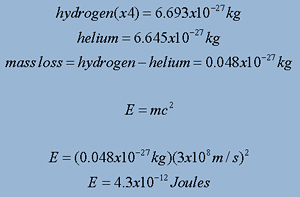
Click to see where I stole this.
Otherwise, there are a few simple concepts of basic classical physics
which make the entire world (...hell, the entire universe) easy to
understand and predict.
Classical physics is the stuff about how things move around
you, without all the math and gibberish like in the blue rectangle above.
You know, stuff like: you drop a ball, and it bounces off the
floor, and it always will bounce off the floor—and exactly the same
way if you drop it the same way.
Therefore,
if you drop the ball from a specific height, it will always bounce back just
exactly an exact specific height, exactly the same way every time.
Guaranteed!
In fact that height is so predictable you can bounce it off the floor again
and again even while running around a room not even looking at it, then throw it just so, and
way over yonder swish... through a hoop.
You know, stuff like that.
You might want to know these things because if you never get around to learning the most basic literal facts about how
objects in the real world behave, you leave yourself open to
an incredible amount of deceit foisted on you by purveyors of magic, myth,
and expensive bicycles.
Stuff like, "Oh, look, there's a quarter behind your ear..." or, "They
don't look and talk like you do, therefore they are total fucking evil
bastards, rotten to the core. They are coming after you, and they deserve
to die," or, "You really need this little doohickey on your bicycle in
order to go fast. It is expensive, but you are worth it. You want to win,
don't you?"
Stuff like that.
Otherwise, if you are familiar with the following few concepts the world is your oyster...
especially if it is the world of cycling.
Knowing these things can help you beat just about anybody who doesn't know them.
Here is the first thing you should know.
inertia - inertia means that things tend to stay just exactly the way
they are, either in motion or at rest. An outside force of some sort is required to
change either situation.
If something is not moving, it takes force to move it. On the other
hand, if
something is moving, it takes force to stop it, and it takes exactly the
same amount of
force to stop it as it did to start it.
Think about that for awhile, look at the things around you, and guess
what all this means for you on your bicycle.
Here are two things it means (I did not make this up):
1) If you get your bicycle moving, it doesn't want to stop. Not only
does it not want to stop, it doesn't even want to slow down... at all.
Something has to happen to make it slow down and stop.
Doesn't that make you happy? If you get your bicycle going at 23
miles an hour, it will stay going that way forever. All you have to do
is avoid the things that would make it slow down and stop (such as brick
walls), and it is
just exactly as hard to make it slow down and stop as it was to get it going in
the first place.
The thought of that gets me pretty excited, except for the part about
the brick wall.
2) On the other hand, if your bicycle is not moving, it doesn't want
to start moving. Not only does it not want to get going fast, it doesn't
want to get going at all. In fact, it takes just as much force to get it
going only a little bit faster as it does to get it going to the speed of
light.
Doesn't that make you happy? You don't need any more effort to get
your bicycle going really fast than you do to just get it going
at all. The thought of that also gets me pretty excited.
You can get your bike going can't you? Then you can get going as fast
as there is. There are a couple minor problems, but they affect everybody
the same way, so you can deal with them.
Here's a little math problem. It is just addition,
subtraction, and division stuff, so not hard in the least. Besides I am giving you the answer right after the question,
so at least try it:
Question: Discounting air and friction (hills don't matter at
all), if you are on your bike going 20 mph, and your speed is increasing
the smallest amount possible, let's call it spinning a 100 watts,
how many more watts will you need to reach 23 mph?
Answer: None.
That answer (None) sounds improbable, but I've done it a few times to
prove it myself.
You can think about that for awhile if you like, but it is absolutely
true, so I am moving on to something else.
Oh, I almost forgot. You might be wondering what force is.
force - force is pow, pop, bang, zingo, and that about covers it as good as
anybody ever has.
Remember I said there are a couple minor problems to deal with: the first
problem is that the air likes to keep you from going really, really fast.
Actually, the air likes to hold you back harder and harder, the
faster and faster you go.
The math word for that is logarithmic, or maybe somewhat parabolic, but I
promised there would be no gibberish here, so forget those words.
Just remember this: the harder you push air, the more pissed off it
gets and pushes back harder and harder the more harder you pushed it back first.
No, that was not a misprint. Read it again more slowly.
Now to prove to yourself that this whole air pushing back harder thing is
true, you will want to experience it first hand, and that is easiest to do if
you trap a significantly smaller amount than is outdoors and push it around
where you can watch.
Best way to trap some air is by getting one of those big gymnasium
instability balls of the kind girls like to sit on pretty and pretend to be
working out, and fill it with about as much air as it will take.
Then put it on the floor and push down on it.
You will notice that if you push down very lightly the "air" moves away from
your hands very quickly and easily, but the harder you push it, the more it
pushes back until finally you could put your whole weight on it and it wouldn't
budge.
Don't worry, those balls are made to take your full weight and not pop: just
don't fall off, because it's not so easy as all those girls sitting pretty make
it appear.
Other than air, nothing except the friction of your bicycle parts plus wheels
on the road will do anything to slow you down, and those things have been so
cleverly avoided by all but the most clumsy of modern bicycles, you only have to
worry about them if your goal is to win a 3 week race over 2,100 miles long, and
even then it is questionable if anything is really going to make much more than
a few seconds difference over the whole course.
Just get hard skinny tires for the road and big knobby ones for rock trails.
Below is a graph that shows you how the air outside likes to make it harder for
you to go faster, and how the harder you go harder the more harder it
likes to make it more harder for you to go more faster.
Once again, that was not a misprint. You will just have to
accept the slight error in grammar,
because like I said, there is a mathematical term for what it describes—logarithmic, but you don't need to know
that term and should try to forget it
as soon as you can. If you use a word like that, people will think you
know something, and they won't let you go on a ride with them.
Otherwise, you might like to be aware that all this stuff (inertia, force, air
resistance) works out best for you on a more or less circular route
beginning and ending in the same place—which by the way takes care of the hills
along with the air resistance (what some people like to call wind).
Anyway, here's the graph:
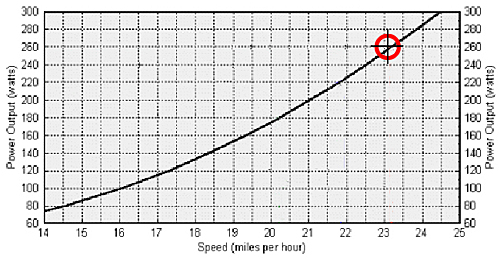
Did you notice the little target just past the 23 mph mark for the Widder
to think about?
See the numbers going up the left side?
Those are the numbers from your power meter (watts). All you have to do
is get your meter showing those numbers, and the numbers across the bottom
(speed) will take care of themselves.
This book is not called Cycling Performance Simplified for
nothing.
The bend in the line on the graph shows just how hard the air
likes to push back on you depending on how hard you are trying to push on it.
If you don't like math, you can have your numbers worked out for you by
my online calculator which tracks well with the chart above based on you putting
in only your watts and weight. It also calculates your Race Category and
is called the
Super Simple Power
to Weight Calculator.
Hills have no effect. They just go up and down
exactly like the bouncing ball described previously and cancel themselves
out, so there is a whole chapter
about how
there are no hills.
There is also a chapter about how
there is no wind,
because there is far too much air (more than 75 miles it just over your
head) for you to be worrying about a little thing like wind.
A headwind will become a tailwind (or the reverse) somewhere about half way
through your loop.
Got it? Good.
See? That wasn't hard... weird maybe, but not hard.
Get your bike going and it won't want to stop, give it a little more juice
(patiently) and you can get it going about as fast as you like.
Remember: a 20 mph pace takes less force on the pedals than is required to
grab a full bicycle water bottle off the floor and place it on a table.
<--
prev |
next -->
|