Updated
September 09, 2022
| By Bob Fugett
Power to Weight Calculator Explained
<--
prev |
next -->

This calculator is the perfect rule of thumb speed per watts calculator.
Before reading below try at least once the free online Power to Weight
Calculator which automatically calculates your power to weight, speed per watts,
and Race Category based on power. Make up some numbers, doesn't matter, won't
hurt a thing.
Caveat: Only part of the story is told by Watts (whether on
the flats or climbing) so be sure to review:
Torque.
1.
How accurate is the
calculator?
2.
Should
I include my bicycle weight?
3.
Can't find formula
"t @ P/W" anywhere
else on the Internet. What does it mean?
4.
What is ETA?
5.
How are watts to mph calculated?
6.
Why is this calculator so much simpler than all others online?
7.
Would
the watts to mph work in an Excel spreadsheet?
8.
Why are race categories calculated
for men only?
1. How accurate is the
calculator?
From the most accurate to the least accurate (descending order) calculator
results are:
- Power to Weight - dead on absolute accuracy (a matter of
simple math)
- Race Category - statistically correct optimistic reporting
based on field data
- Watts to Speed - in the ballpark though slightly more optimistic
than Race Category
- ETA - the most likely to be in error and still under
investigation (11/29/09)
2. Should I include my bicycle
weight?
Consistency is the most important thing, and the best way to get consistently repeatable accurate weight measurements is to use your naked
morning weight.
Of course, sharper accuracy can be achieved at any given moment by
carefully weighing bicycle, water bottles, clothes, tools, and ancillary
components as well, but for tracking your own long term performance those
elements have less value if you do not precisely control weight
measurement in the exact same way every time.
For comparison with other riders, it is unlikely you will find enough
detailed information about their setup to make any extra work on your part
meaningful anyway.
If you are a coach/trainer for a team, all equipment and bicycle weight
should already have been conformed to a uniform standard, so naked morning
weight should work for you as well.
In cases where a few seconds or watts is going to make the difference
in who makes the team or not, or who is going to handle what team job
during the next race, careful attention to absolute ride weight (as
opposed to naked morning weight) is absolutely warranted.
Probably this discussion has been expanded beyond minimal necessity
because I like giggling after repeating, "...naked morning weight."
3.
I can't find the formula "t @ P/W" anywhere
else on the Internet. What does it mean?

It stands for the amount of time (t) you can hold a specific power (P,
in watts) relative to your weight (W, in kilograms).
Stating this concept as the formula t @ P/W is unique to Cycling
Performance Simplified and undoubtedly represents the most refined and
useful way to assess your cycling ability ever.
Track your development based on the amount of time you can hold any
given watts, and everything else will fall into place.
The Allen and Coggan table (presented by the
Power
to Weight Calculator) takes this idea one step further by dividing required efforts into time categories which account for best sprinter,
best jumper, best pacer, and best long haul time trialist.
My
online calculator does a quick and rough spotting of your Race
Categories, but you should compare
your own real world results at 5 sec, 1 min, 5 min and FT to the Allen and Coggan table
(presented with the calculation) in order to get a baseline on how you stack up to other
riders.
Over the widest possible range of riding
conditions and courses (discounting team tactics), the rider who holds the highest power to weight
ratio for the entire ride or race will always be the winner.
Once you have a handle on your current level of performance based on a
simple objective repeatable reference you can work rationally to improve.
This simple formula (t @ P/W) and the concept it embodies is the basis for everything else in
Cycling Performance Simplified, so it has its own page:
t @ P/W.
4. What is ETA?
ETA stands for: Estimated Time of Arrival, but in this case
it means not to a location but to a terminal velocity.
It is useful to have an understanding of how quickly you can achieve
quoted speeds such as 300 watts = 25 mph.
If you start at zero you will not be immediately at 25 mph.
In order to control re-pacing efforts after hard turns and
interruptions during time trials, you can use the ETA as a rule of thumb
reference for calculating how long at what effort you need to push in
order to get back up to pace.
Since your power meter gives a more immediate absolute reference to
your actual pace (where current mph speed is always misleading), you can
use the ETA number in order to plan your handling of technical
difficulties such as extra tight turns and road intersections found on
your time trial course.
The formula was taken from an automotive website discussing calculation
of 0-60 times then confirmed
through review of mechanical physics, motion, and math resources along
with empirical real-world testing.

5.
How are watts to mph calculated?
The formula is well known, and
Wikipedia provided enough information
about dimensionless constants that are typically used in order for SlingShot to get
this formula
up and running.

Suffice it to say that simplifying rational assumptions were applied to
friction and weight variables.
More information can be found on Wikipedia at:
Bicycle performance.
6.
Why is this calculator so much simpler than all others online?
As mentioned in the Wikipedia article discussing the formula above,
"...simplifying assumptions..." have been made (and of necessity always
will be made) by all such calculators, so here we jumped right to the heart
of the matter without offering blinding distractions from minor details of questionable
utility.
7. Would the watts to mph work in an Excel
Spreadsheet?
Sure, here is the formula:
=SUM(SQRT((2*A1)/(9.8067*A2*0.0053)+0.185)*60*60/1000*0.621371192)
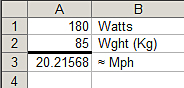
See
question 5 for the source of the formula above.
Constants used in the formula above are:
| 9.8065 |
= constant for gravity |
| .0053 |
= lump constant for frictional losses (chain,
tires, etc) |
| 0.185 |
= lump constant for aerodynamic drag |
| 0.621371192 |
= conversion of kilometers to miles |
8. Why are race categories calculated
differently for men
and women?
Your guess is as good as mine, because nobody has ever shown convincing evidence there is a
substantial difference between the athletic potential of men compared to
women.
Women are certainly capable of competing with men, so why waste time
leading riders astray?
[
Go to top |
Back to Calculator ]
<--
prev |
next -->
|